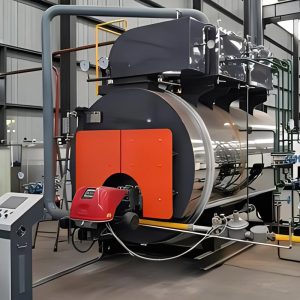
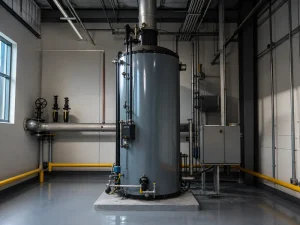
Use a steam boiler when your process needs phase-change heat delivery above 100°C, or when regulations mandate steam sterilization. Use a hot water boiler when you need precise, continuous heat transfer without phase change. Pressure class and process temperature — not boiler type alone — determine the right fit.
This guide covers industrial and commercial boiler selection. It does not apply to residential HVAC, domestic water heaters, or consumer equipment. EPCB Boiler’s engineering team produced this guide based on field specifications and industrial applications.
How These Two Boiler Types Work — and Where the Specs Diverge
Hot water boilers and steam boilers differ in three key ways: operating temperature, pressure class, and heat delivery mode. Each variable affects your process design independently.
Hot water boilers (also called hydronic boilers or hot water generators) circulate pressurized water through a closed loop. Water stays liquid throughout. Standard designs operate between 60°C and 93°C. High-temperature hot water (HTHW) systems can reach up to 116°C, depending on system pressure and local regulatory classification. Heat transfers by convection and conduction.
Steam boilers heat water past its saturation point to produce steam at controlled pressure. Low-pressure steam boilers run below 15 psi (103 kPa) gauge. High-pressure units exceed that threshold — reaching 150 psi (1,034 kPa) or more in industrial configurations. Heat delivery works through latent heat of vaporization, a different mechanism with higher energy density per unit mass. Understanding how each component fits into a complete industrial steam boiler system helps clarify where these parameter differences show up in practice.
| Parameter | Hot Water Boiler | Low-Pressure Steam | High-Pressure Steam |
|---|---|---|---|
| Typical operating temp | 60°C–93°C (standard); up to ~116°C (HTHW) | ~100°C at ≤15 psi; varies with design pressure | 120°C–230°C+ (pressure-dependent) |
| Operating pressure | Typically ≤1.6 MPa (standard designs) | ≤103 kPa (15 psi) gauge | >103 kPa, up to ~10 MPa |
| Heat delivery | Sensible heat via circulating water | Latent heat via steam condensation | Latent heat via steam condensation |
| Phase change | No | Yes | Yes |
| Regulatory hazard class | Lower (depends on design pressure) | Moderate | High — triggers stricter oversight |
Verify all values against ASME BPVC, EN 12952/12953, or the equivalent standard adopted in your jurisdiction. Confirm which version is currently in force before finalizing specifications.
These parameter differences are not abstract. They determine which industries can substitute one system for the other — and which cannot. Steam and hot water are two of several types of industrial boilers that differ in heat delivery mode, pressure class, and regulatory classification.
The Common Misconception: “Steam Is More Powerful, Hot Water Is Safer”
Neither claim is correct as a general rule.
Steam’s latent heat density is higher per unit mass than sensible heat in water. That’s true. But it’s irrelevant if your process doesn’t require phase-change delivery. Forcing a steam system into a closed-loop indirect heating application adds complexity, maintenance obligations, and compliance burden — with no process gain.
The safety assumption is equally flawed. HTHW systems above 120°C and 1.0 MPa carry regulatory obligations comparable to high-pressure steam in most jurisdictions. Pressure class and operating temperature determine safety classification — not whether the fluid is liquid or vapor. At equivalent pressure and temperature, neither system type is inherently safer.
We see the same pattern at EPCB Boiler: assumptions about steam “power” and hot water “safety” drive more misspecified procurement decisions than any other single factor.
Which Industries Require Steam — and Which Work Better with Hot Water
The deciding factor is whether your process needs phase-change heat delivery, direct steam contact, or regulatory-mandated steam sterilization.
Processes that require steam boilers:
- Textile steaming and dyeing: Saturated steam penetrates fiber structures. Pressurized water cannot replicate this under standard textile processing conditions. Selecting the right steam generator for textile industry applications depends on fiber type, dyeing cycle length, and required steam pressure.
- Food sterilization and retort processing: Most food safety codes specify steam contact at defined temperature-pressure-time parameters. Hot water cannot substitute. The steam boiler types used in food industry settings vary by process — retort, CIP, and pasteurization each have different pressure and capacity requirements.
- Pharmaceutical autoclave sterilization: GMP regulations — including FDA guidance and the European Pharmacopoeia — require saturated steam at 121°C–134°C for standard autoclave cycles. Alternative sterilization methods exist but require separate regulatory validation outside standard boiler scope. Boiler selection for pharmaceutical plants also needs to account for cleanroom compatibility, validation documentation, and GMP audit requirements.
- Chemical reaction heating with direct steam injection: Some chemical processes use steam as a reactant or carrier. Hot water cannot serve this function regardless of pressure.
- Paper and pulp processing: Digester and drying operations are built around steam phase change from the process design stage.
Processes better served by hot water boilers:
- District and process heating networks: Hot water systems offer precise temperature control and simpler pressure management over long distribution distances. They are the standard choice in most contemporary district heating designs.
- Chemical indirect process heating: Reactor, vessel, or heat exchanger heating where temperature stability matters more than heat density. HTHW systems handle this well within their design range.
- Food and beverage CIP and vessel jacket heating ≤130°C: Hot water delivers more consistent, controllable heat in these configurations.
- Greenhouse and agricultural heating: Large-area, low-temperature continuous heating. Hot water is more efficient and operationally simpler than steam here.
- Plastics and rubber jacketed tooling: Molding and extrusion processes benefit from temperature precision and closed-loop pressure control — both easier with hot water.
Once you’ve confirmed whether phase change is a hard requirement, the next decision driver is lifecycle cost.

Energy Efficiency, Maintenance Burden, and Total Operating Cost
When procurement teams compare these systems on lifecycle cost, the outcome depends on process type and pressure class. No single number applies across all installations.
Hot water boilers in closed-loop configurations achieve higher steady-state thermal efficiency than steam boilers under equivalent load conditions. Closed loops eliminate the latent heat losses at distribution points that steam systems incur. This advantage is strongest in condensing designs with low return-water temperatures. In well-maintained steam systems with high condensate recovery rates, the efficiency gap narrows significantly. The correct comparison requires site-specific inputs: condensate return rate, load profile, fuel type, and insulation quality. The efficiency of an industrial steam boiler under real operating conditions depends on how well each of those variables is managed.
Steam trap maintenance is a recurring cost that hot water clients don’t face at the same frequency. This shows up consistently in EPCB Boiler’s textile and food processing steam projects. Failed or aging traps push system losses to between one and ten percent of circulating volume. Those losses translate into make-up water costs, chemical treatment overhead, and reduced effective efficiency. Consistent steam boiler maintenance — covering trap inspection cycles, blowdown frequency, and water treatment — is what keeps those losses at the low end of that range. Closed-loop hot water systems still require water quality management and pump maintenance — but the make-up water burden is structurally lower.
In most North American and European jurisdictions, high-pressure steam systems (above 15 psig) require a licensed stationary engineer or equivalent certified operator. Many hot water systems below defined pressure and temperature thresholds qualify for lighter certification tiers. Verify requirements against local code before procurement. Steam systems also carry higher installed capital cost. Steam distribution infrastructure, trap arrays, condensate return systems, and pressure vessel classification requirements all add to the initial investment.
The cost structure alone doesn’t resolve the selection question for regulated facilities. Compliance obligations add a separate layer of variables.

Pressure Ratings, Safety Classification, and Regulatory Compliance
Above 15 psig, regulatory obligations diverge sharply between steam and hot water systems. Those differences compound across inspection cycles, operator certification, and insurance classification.
Most jurisdictions follow ASME BPVC or equivalent national standards (EN 12952, EN 12953, AS/NZS 1200). Under ASME BPVC, steam boilers fall into two classifications: Section I (Power Boilers, above 15 psig) and Section IV (Heating Boilers, at or below 15 psig). Hot water systems follow the same boundary — Section IV covers systems at or below 160 psig and 250°F. Above those thresholds, a hot water system classifies as a Section I Power Boiler. It carries the same obligations as a high-pressure steam system. Confirm which version of each standard your jurisdiction has adopted before finalizing specifications.
Classification governs four areas:
- Inspection frequency: High-pressure steam boilers typically require annual or periodic third-party inspections by authorized agencies. Some jurisdictions require a licensed operator on-site during operation.
- Operator certification: Above 15 psig, most North American and European jurisdictions require a licensed stationary engineer or boiler operator certificate. Requirements vary by jurisdiction — confirm locally before procurement.
- Insurance and liability: Pressure vessel classification affects underwriting. Misclassifying a system’s pressure rating creates coverage gaps.
- HTHW regulatory position: HTHW systems above 120°C and 1.0 MPa often carry obligations comparable to high-pressure steam. Do not assume hot water means lighter compliance at elevated pressure.
The compliance cost difference between pressure classes can equal or exceed the equipment cost difference over a five-year operating cycle. With those variables mapped, the decision matrix below consolidates each selection factor into a single reference.
Boiler Selection Decision Matrix
Boiler type selection turns on process temperature, phase-change necessity, pressure class, and local compliance requirements. This matrix maps those variables to a pre-contact recommendation.
| Process Condition | Recommended Type | Primary Reason |
|---|---|---|
| Phase-change heat or direct steam contact required | Steam boiler | Process physics require vapor delivery |
| Pharma autoclave / food retort sterilization | High-pressure steam | Regulatory mandate (GMP, food safety codes) |
| Textile steaming / dyeing | Steam (low or high pressure, per process spec) | Saturated steam required for fiber penetration |
| Paper / pulp digester or drying | High-pressure steam | Process design built around steam phase change |
| District heating network | Hot water boiler | Precise temp control; simpler pressure management |
| Chemical indirect heating within HTHW design range | Hot water boiler | Temperature stability; closed-loop efficiency |
| Food/beverage CIP or jacket heating ≤130°C | Hot water boiler | Controllable temp; no phase change required |
| Greenhouse / agricultural heating | Hot water boiler | Low-temp continuous heat; simpler operation |
| Plastics / rubber jacketed tooling | Hot water boiler | Temperature precision; closed-loop pressure control |
| Temps exceeding HTHW design limits | High-pressure steam | Hot water systems are bounded by design pressure |
| Budget-constrained; compliance overhead a priority | Hot water boiler (if process permits) | Lower capital cost; lighter licensing (verify locally) |
| High condensate recovery feasible | Steam efficiency improves | Recovery narrows the efficiency gap |
How to use this matrix:
- Identify your process temperature and confirm whether phase-change delivery is required. If multiple rows apply, the most restrictive condition governs.
- Cross-check the recommended type against your local pressure class requirements. Use the primary reason column to validate the match before contacting a supplier.
Conclusion
The right boiler type depends on process temperature, phase-change necessity, pressure class, and local compliance requirements. Assumptions about which type is “more powerful” or “safer” don’t hold across industrial applications.
Use steam when your process requires phase-change heat delivery, direct steam contact, or regulatory-mandated steam sterilization. Use hot water for indirect process heating, district heating, and temperature-controlled applications where operating complexity and steady-state efficiency matter.
The most costly procurement errors we see at EPCB Boiler don’t come from wrong capacity choices. They come from applying the wrong boiler type to a process that could have been matched correctly at the specification stage.
If your process sits at the boundary between steam and hot water suitability, or if multiple matrix rows apply, contact EPCB Boiler’s technical team for a process-specific evaluation. We assess operating parameters, pressure class, and compliance requirements before recommending a configuration.
FAQ
Can steam and hot water systems operate in the same facility?
What happens when steam traps fail?
What should I evaluate before converting from steam to hot water?
What regulatory steps are required before commissioning?
Get Your Custom Boiler Solution
Our engineers analyze your requirements and deliver a tailored boiler system — from capacity sizing to fuel optimization.